Ryan Lee 2026
June 25 – August 21, 2026
Niu Systems
Ryan Lee Gallery
515 W 26th St floor 3, New York, NY 10001
Opening reception
Thursday, June 25, 2026, 6:00-8:00 pm
Review Artwork PDF
Download Press Release
Including work by Kaili Chun, Sean Connelly, Pier Fichefeux, Kainoa Gruspe, Amber Khan, John Koga, Roland Longstreet, Nicole Parente-Lopez, Nanea Lum, Dane Nakama, Enoka Phillips, Nalani Sato, and Lawrence Seward
RYAN LEE Gallery is pleased to present Niu Systems, a group exhibition of contemporary artists from Hawai‘i. Niu is not a coconut. This distinction is not merely linguistic. Where “coconut” names an object for consumption, niu holds layers of ‘ike (knowledge): husk, shell, water, flesh, each revealing itself only through time, care, and engagement. Niu is a relation, not a resource. It carries genealogy, voyaging histories, ancestral planting practices, and future sustenance. Every part has purpose; nothing is isolated; nothing is wasted. To encounter niu is to slow down, to work with one’s hands, to engage in process rather than extraction. It becomes kumu, a teacher, reminding us that knowledge is not taken but revealed through relationships.
Niu Systems takes this framework as its ground. The exhibition does not treat niu as metaphor or decoration, but as a model for how the works here coexist: as distributed, interdependent parts of a larger structure, each distinct, each inseparable from the whole. On islands, time does not move forward. It gathers. Histories accumulate, materials circulate, and relationships to land deepen. In Hawai‘i, ancestral knowledge, migration, and contemporary movement overlap within a compressed geography. Land is not distant. It is encountered through use, through memory, and through the conditions of daily life.
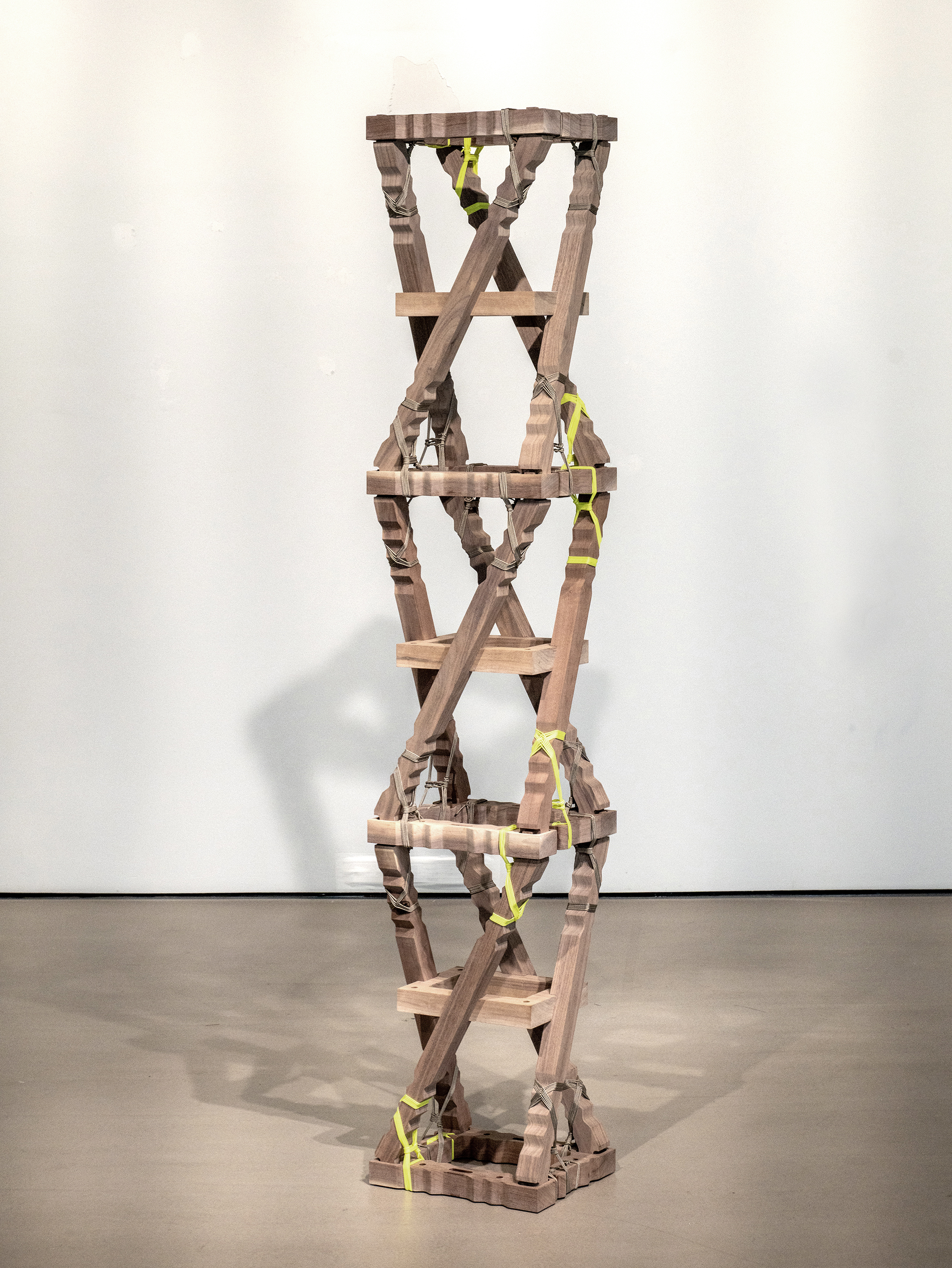
Amber Khan employs niu cordage alongside wood and metal, binding organic and constructed elements where every binding carries both physical and cultural tension. Sean Connelly’s structures rely on lashing and compression, holding form through balance rather than fixed joinery, a logic the niu itself enacts. Kainoa Gruspe maps surface and accumulation, where fragments of environment, sand, line, debris, become quiet records of movement and contact. In Dane Nakama’s panels, shells, pumice, and sand are embedded directly into the work, collapsing image and shoreline into the same plane.
Nanea Lum’s use of kapa and video extends material into duration, making process and time visible within the work. John Koga and Enoka Phillips both engage the inherited weight of objects, how things carry histories that exceed their surfaces. Nalani Sato positions pōhaku within domestic interiors, shifting land into spaces of habitation and memory. Nicole Parente-Lopez isolates the form of a single stone, rendering it as both object and field. Roland Longstreet and Pier Fichefeux approach Hawai‘i from positions shaped by movement and distance, engaging the islands as sites of encounter, observation, and projection, perspectives that do not resolve into a singular view but exist in active relation to the others.
Lawrence Seward’s contribution brings the niu into direct sculptural presence. His works are not literal coconuts but representations: painted, assembled forms that invoke the niu’s physical layerswhile opening onto something stranger and more interior. Organic materials, found objects, and bold surface treatments accumulate on forms that read simultaneously as vessel, organism, and world. Where other works in the exhibition engage niu as structural logic, Seward’s pieces make its body visible – the husk, the opening, the held interior – as sites of mystery and meaning rather than utility.
The conceptual grounding for the exhibition draws in part from the thinking of Kaili Chun, whose work is also included here. Chun’s articulation of niu as a relational framework, one that holds layers of ‘ike rather than a single extractable use, shapes how the exhibition understands its own materials and positions. Her contribution to the show reflects this same integration of concept and form.
Together, the works in Niu Systems do not argue for a single relationship to land, material, or time. Some are grounded in genealogy. Others arrive through migration or temporary presence. What the exhibition holds is not a unified narrative but something closer to what the niu itself demonstrates: a system where each part participates in the whole, where use is inseparable from responsibility, and where meaning is not extracted but revealed slowly, through attention, care, and relationship.
Niu Systems is curated by Jon Santos within Ontopo, a platform spanning performance, installation, and exhibition formats across sites and disciplines. This presentation continues Ontopo’s exhibition track centering Hawai‘i-based artists.
